Workshops
Aylin Vartanyan
Expressive Arts Practitioner
Duygu Aşık
Education Specialist, Visual Facilitator
inVISIBLE TRACES? workshops began with the coming together of Greek (Rum), Jewish, Antakyan Orthodox, and Armenian women living in Turkey — with the shared intention of looking together at the invisible line between vulnerability and resilience.
Behind Zoom screens, the women connected from inside her own home became part of this process not only with their voices but also with their spaces, their objects, and the texture of their everyday lives. Homes were never just backgrounds; they turned into living spaces of memory, emotion and remembering.
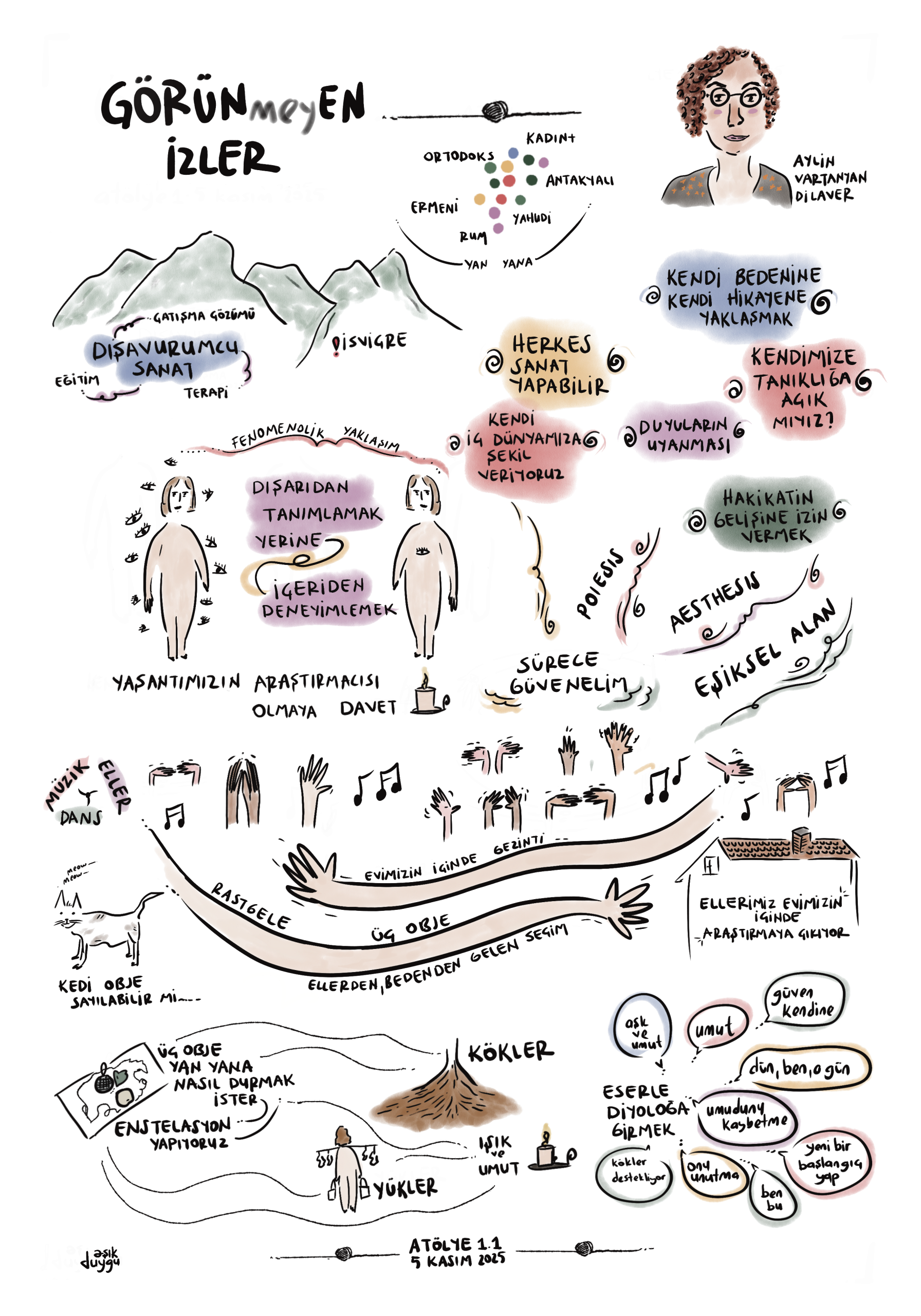
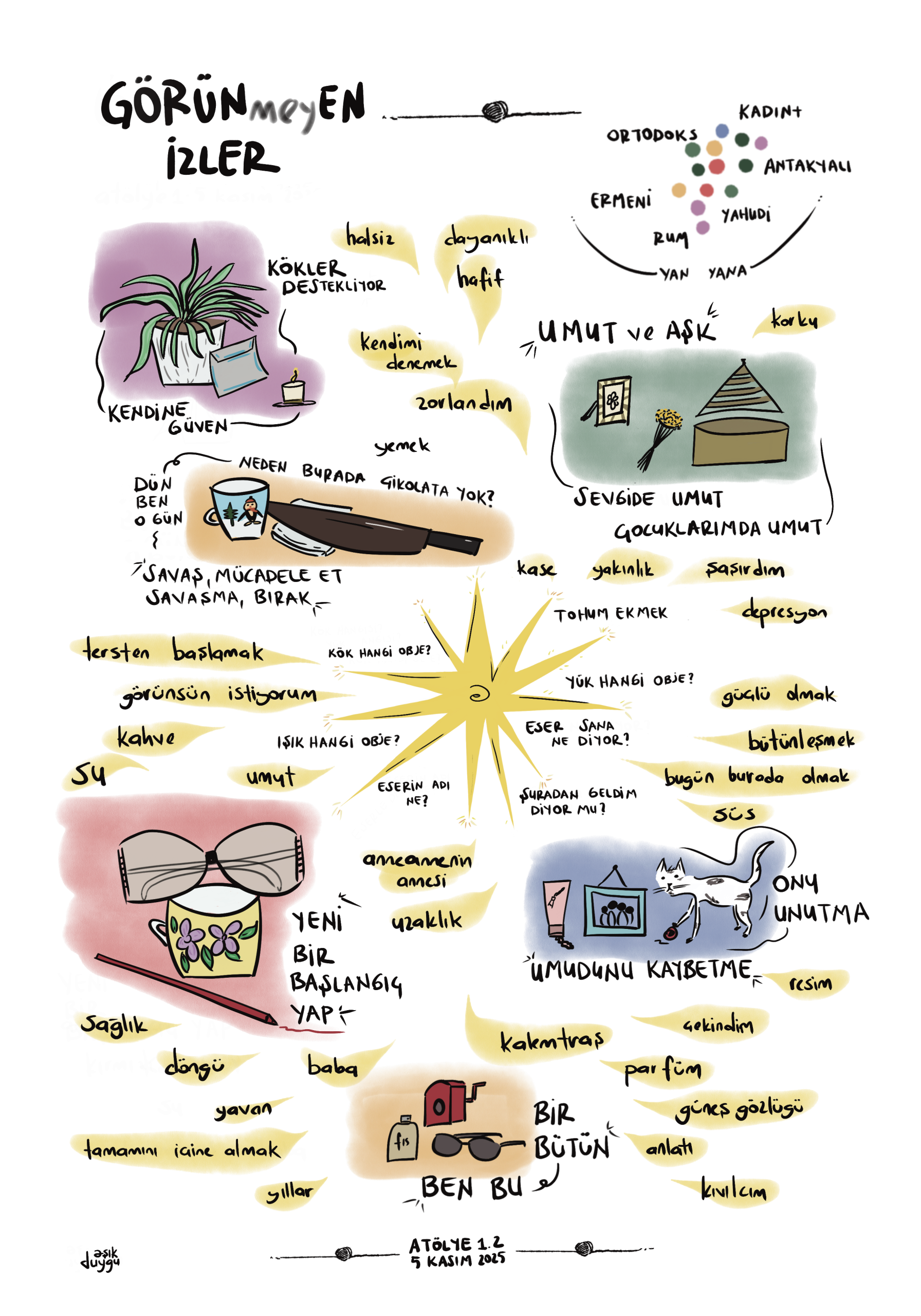
The work opened with the question “Who are we?”. Participants shared not only their names but also why they participated: they talked about places called up by memory, their relationships with art, the personal connections they had woven with unseen traces… This sharing created the first circle of a safe and egalitarian space. After a brief introduction to the expressive arts approach, the work continued activating the participants bodies. The bodies were gently awakened through a short movement exercise focused on the memory of the hands. Then each participant took a brief walk through her home and chose three objects: one representing her roots, one her burdens, and one her hopes. These objects were not merely selected; they were invited to “speak” through the distances, closenesses, orientations, and postures they formed with one another. Participants transformed them into installations, adding their own “traces” around them with string and drawings. This stage strengthened the understanding that artistic making is not about producing an obligatory outcome but about opening a space for witnessing and being. The drawings and objects became a quiet narrative that rendered visible the relationships between participants’ roots, burdens and hopes. Each woman spent time alone with her work, thus being encouraged to ask the question: “If this installation could speak, what would it say to me?” In the group, each woman presented their installations and described what they experienced producing the installation. The others responded with an “aesthetic echo” — offering non-judgmental, reparative witnessing. In this way, individual experiences became a collective space of listening.
Illustrator: Duygu Aşık
The workshop closed with the reminder that art goes beyond being a “healing tool” — it is a poetic process that deepens our capacity to re-connect with life. Participants were gently invited to continue noticing “unseen traces” in daily life through small aesthetic journals, sustaining relationships with objects, and entering into dialogue with their creations.
This workshop did not seek to forge a single common language; instead, it created a polyphonic space of witnessing. An aesthetic field where silences, small recollections, fragility and resilience could be heard together… And perhaps most importantly: an encounter that recalled how unseen traces are at once burden and power.
Illustrator: Duygu Aşık
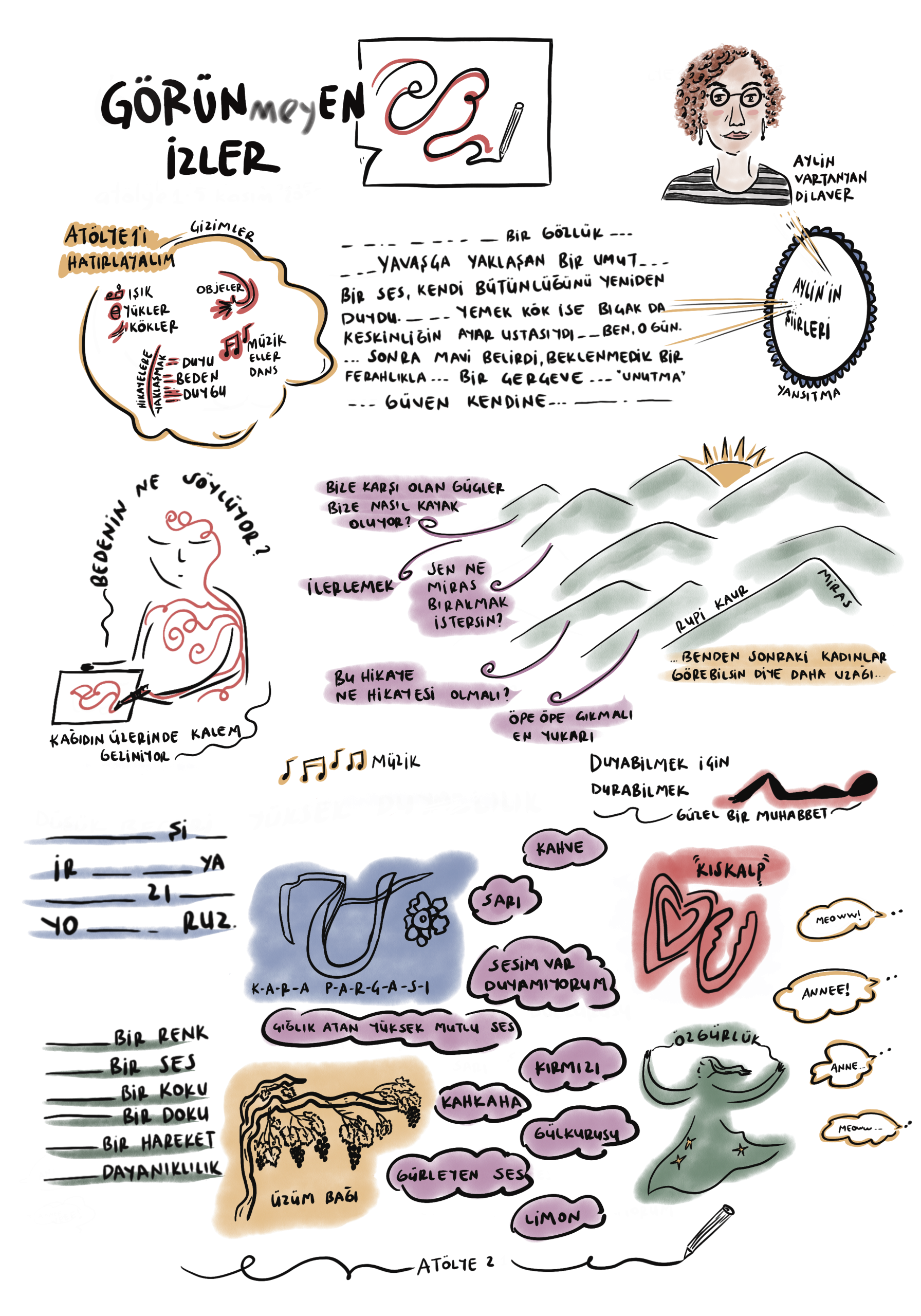
The programme’s second phase was deepened through one-to-one conversations. Each woman’s story was singular; every shared experience carried its own unique way of listening, enduring and transforming. In this phase we deliberately invited poetry to accompany us. In particular, the poems of the Indian-origin poet and illustrator Rupi Kaur accompanied us. We chose her not only for the beauty of her words; her language is plain yet never shallow — it gently opens a deep space for reflection on vulnerability, intergenerational transmission, the loads and strengths carried by women’s bodies and souls. Rupi Kaur is a voice reminding us that healing begins not on the surface but at the root. She accompanies us, so we can see the heritage women carry not only as pain but also as strength and light.
Her words met the heart of this work. As she says in one poem:
…
deep inside somewhere
there is a beautiful conversation
you must listen closely
to what your inner world is saying
…
These lines invited each participant to turn an ear to the “beautiful conversation” within herself; sometimes quiet, sometimes fragile, but always carrying — that inner voice. In another poem she reminded us that we stand upon the legacy left by millions of women before us and bear the responsibility of passing a light forward. Thus the second gathering became not merely a revisiting of past challenging experiences, but a process of discovering how those experiences have left behind a field of resilience and light in the present. Through short drawings, small gestures, and deep moments of reflection, each participant made her own light visible once more.
Illustrator: Duygu Aşık
The inVISIBLE TRACES? workshop series became more than an art activity — a meeting place reminding us that vulnerability also holds the potential for solidarity and empowerment. Beginning inside homes, the process opened toward inner worlds and from there reached out again to one another. Every story was listened to with respect, held in non-judgmental witnessing. And perhaps most precious of all, each woman left feeling that her own resilience story speaks not only from the past but also from the present and the future — remembering anew that light multiplies when it is shared.
Aylin Vartanyan
Educator, Expressive Arts Practitioner
Aylin Vartanyan Dilaver is an educator and researcher who places the transformative power of art at the center of learning and healing processes. She studied political economy and literature at Barnard College and Columbia University; for many years she taught critical reading and writing at Boğaziçi University and was one of the founding educators of its Peace Education Center. Her 2005 encounter with Augusto Boal’s Theatre of the Oppressed approach inspired her to view art as a language of social change and to use creativity to create safe spaces for shared expression. She completed her doctoral work (begun in 2010) at the European Graduate School with research that brought together the silence and remembering experiences of Armenian women living in Istanbul through digital storytelling and post-memory perspectives.
Since 2011 she has been facilitating expressive arts workshops centered on grief, emotional resilience, intergenerational memory, and ecological healing (ecopoiesis). Her work aims to open inclusive, safe spaces where participants can approach their own stories and bodily wisdom with compassion. In the aftermath of the 2023 earthquake, she designed and led trauma-sensitive expressive arts workshops in Istanbul, Gaziantep, Mersin, and Hatay with teachers, NGO workers, youth, and those in psychosocial support roles — helping communities activate their own resources.
She continues as an educator at the Expressive Arts Institute in Istanbul while designing art-based learning environments inside and outside universities. She writes texts interwoven with personal memory, collective witnessing, and aesthetic inquiry, and is a founding member of the Parrhesia Collective of Armenian women academics and artists.
Duygu Aşık
Education Specialist, Visual Facilitator
Duygu Aşık is an education specialist who runs trainings and workshops on rights-based conceptual topics, well-being, creative writing, and illustration. As a visual facilitator, she merges personal narratives, group narratives, and educational flows with her own way of seeing, visualizing them through digital drawing. She constantly writes, draws, and walks.
In 2009, while volunteering in university rights-based initiatives, Duygu Aşık graduated from the Department of Labor Economics and Industrial Relations in 2014. During this period she was deeply influenced by the transformative power of non-formal education environments and continued professionally in education. She has carried out and continues to carry out rights-based work with various civil society organizations, private sector entities, and public institutions. She is expert in working with diverse groups, designing and facilitating education and workshops, and using dialogue and tools to bring forth the group’s wisest state. She incorporates Deep Democracy tools and a Nonviolence approach in her practice.
In 2017, while engaged in gender studies, to repair accumulated emotional exhaustion and reconnect with herself, she turned to walking, story writing, storytelling, and drawing. By examining, writing, telling, and illustrating her own personal story, this process transformed her. Following her personal transformation, she combined her expertise in learning-nourishing environments with illustration and writing. Since 2023 she has been running workshops on Well-being, Writing, Play, and Drawing themes, and digitally illustrating learning environments and narratives.