
Women Who Pedal
Rea Stathopulu
Boğaziçi
15 June 1955, Wednesday
Dear diary,
Pinch
Today Grandma took a small napkin from the buffet, put it on her head, and said she was going to Samatya to visit her father. Margarita and I nearly died laughing. Mom tried to stop her and called me for help. Grandma is short, thin, skin and bones, but so strong, so strong… It’s from nerves, Mom says. People get very strong when they’re angry.
Grandma had just calmed down when we heard the little bell of great-aunt. We ran to the other room. But Mom pushed us out and closed the door…
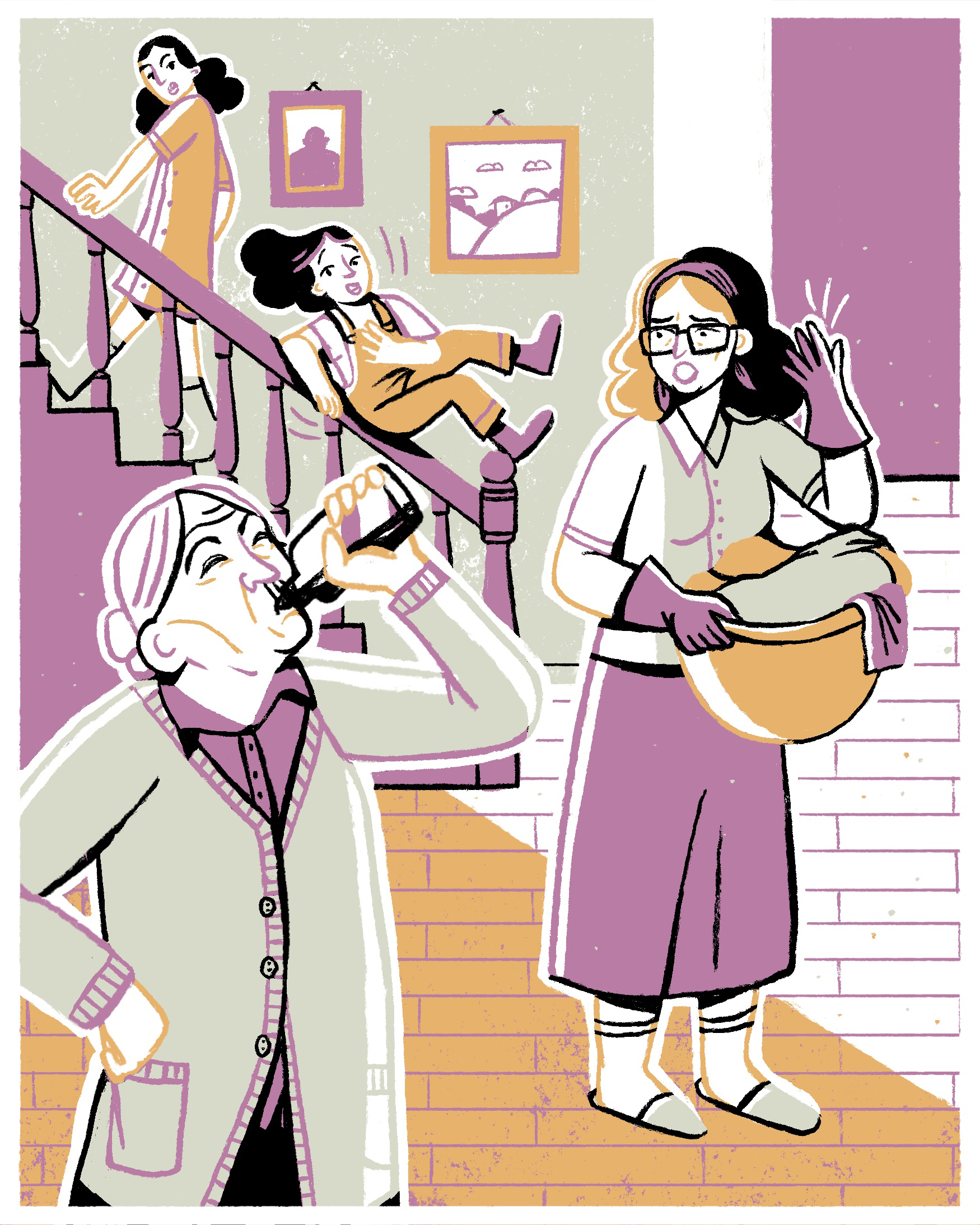
Margarita and I started sliding down the banister. It’s our favorite game. We stomp our feet hard climbing back up, I go crazy over the sound the wooden steps make. The whole house shakes, we scream as we slide down. Of course we don’t do this when the tenants are home; good thing they work and aren’t here all day.
Mom appeared for a moment with a pile of dirty laundry in her arms, then went down to the laundry room and disappeared. Great-aunt must have done it on her again. If it were me, I’d be disgusted washing those filthy clothes. But Dad bought Mom a pair of pink rubber gloves. She doesn’t touch the dirt with her hands.
Good thing Grandma’s here. Every day she does something crazy, and we have fun. Yesterday she drank a bottle of Sofia’s ink. Thought it was liqueur. She knows tastes. Mom tore her hair out, “What if she falls and dies now?” But look at Grandma’s answer, mouth still blue with ink: “Why are you yelling over some fake liqueur? I’ll pay for it, buy a new one…”
Isn’t it strange for a girl’s diary to start with a grandmother who’s regressed to babyhood? Margarita thought. She’s known since she can remember that Grandma Klioniki lost her mind. She heard detailed stories from her mother about Grandma’s life in distant Samatya, Istanbul. On the shore of the Marmara Sea, in a house facing another sea, she raised four children with strict discipline. When her daughters went to church, everyone’s eyes were on them from afar. “Look, here come ‘Hunchback’s girls,’” the Turks would say, puffing nargile in the coffeehouse, pointing at the three girls’ shining clean blonde hair in the sun. Her son grew up there too; the boat-scrap son she sent heartbroken to America later, to his sibling, to find his own way.
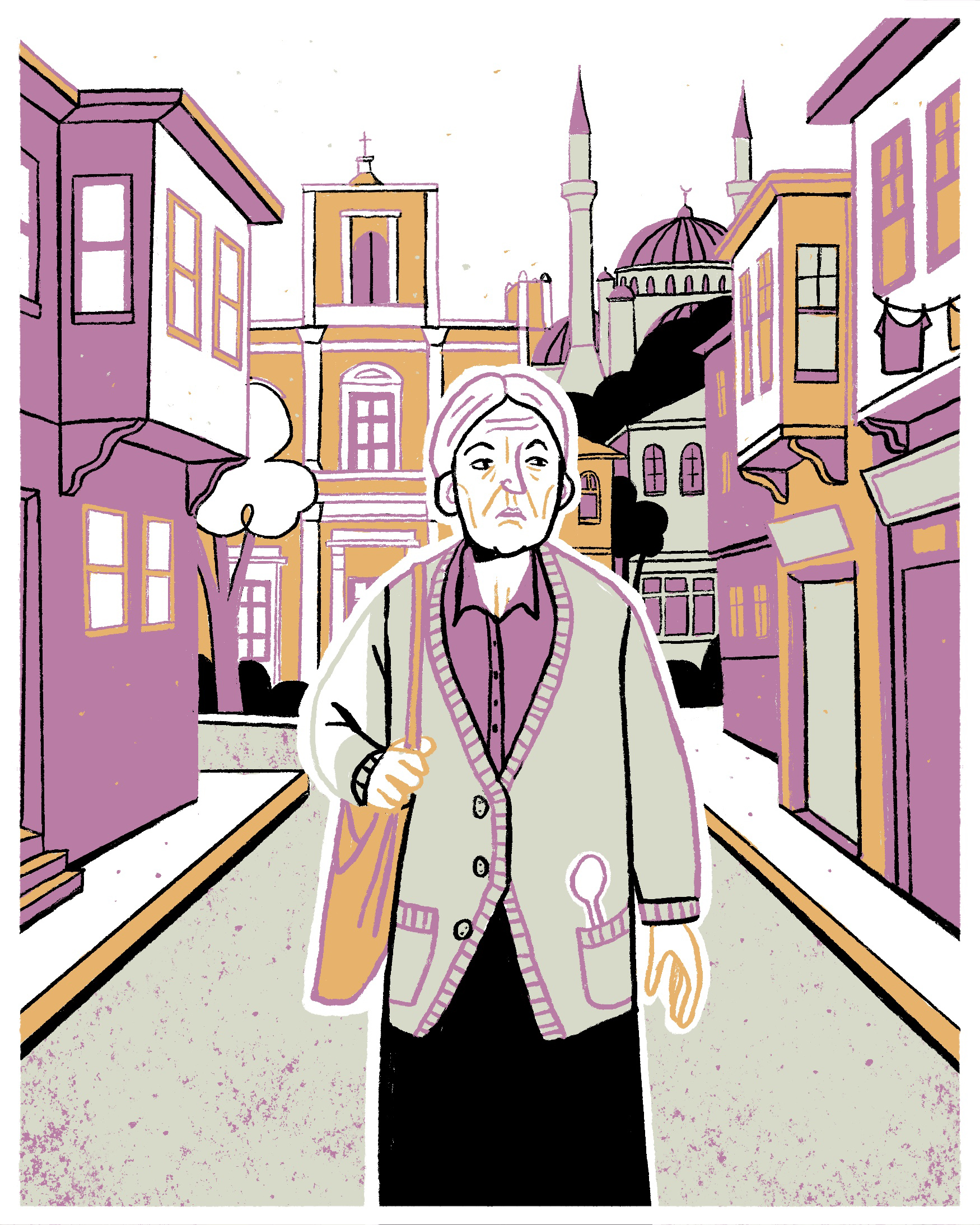
Kosta used to say it was very hard at first to believe such a thing happened to his mother-in-law. This woman who ran her house like a man, disciplined, calculating, with an iron fist — much older than her husband who died suddenly before the son-in-law even knew him — suddenly started giving away all her money to Turkish children, and when the money ran out complaining that the government was paying pensions in longer and longer intervals… According to Grandma, the government was pulling tricks to pay poor people less pension in a year. Klioniki received her husband’s pension; her husband was one of the masters in a workshop making stripes for Turkish army uniforms.
Once, when she came home from a visit with the spoon from the offered dessert in her pocket, everyone understood Grandma was no longer the old Grandma. From then until the day she died, she kept dreaming of running away from home. Run away from the household whose members she no longer knew, from today that terrified her, take refuge under the safe wings of the past, go to Samatya preserved as the only memory in her mind, take shelter under the warm father’s hearth roof.
…But those were yesterday; today Virginia Aunt tells me to write what happens to me every day. Write as if talking to a friend. And add your thoughts, she says. So I’ll write in my diary as I think. Even if I don’t tell my friends everything I think…
Now, after the introduction, to today.
While Margarita was screaming sliding down the banister and I was stomping my feet hard climbing the steps, the front door opened and our dreamy little lady, our big sister Sofia, appeared at the door. According to Virginia Aunt, Sofia is “precocious.” Maybe that’s why she’s so crazy. One moment she passes us without noticing, the next she yells at us for no reason, and very rarely caresses us, sings songs. Her voice is very beautiful.
Sofia’s voice… Margarita pictured her big sister singing. Because it wasn’t just her voice that was beautiful, the passion in her voice, tilting her head to the side, using her hands while singing… For years Margarita thought if she tilted her head while singing her voice would sound better. In the “Ascension” section, when Sofia sang the hymn “They Adorned Her Grave with Flowers,” you felt the whole congregation’s skin tingle. People would lose themselves in complete awe listening to her…
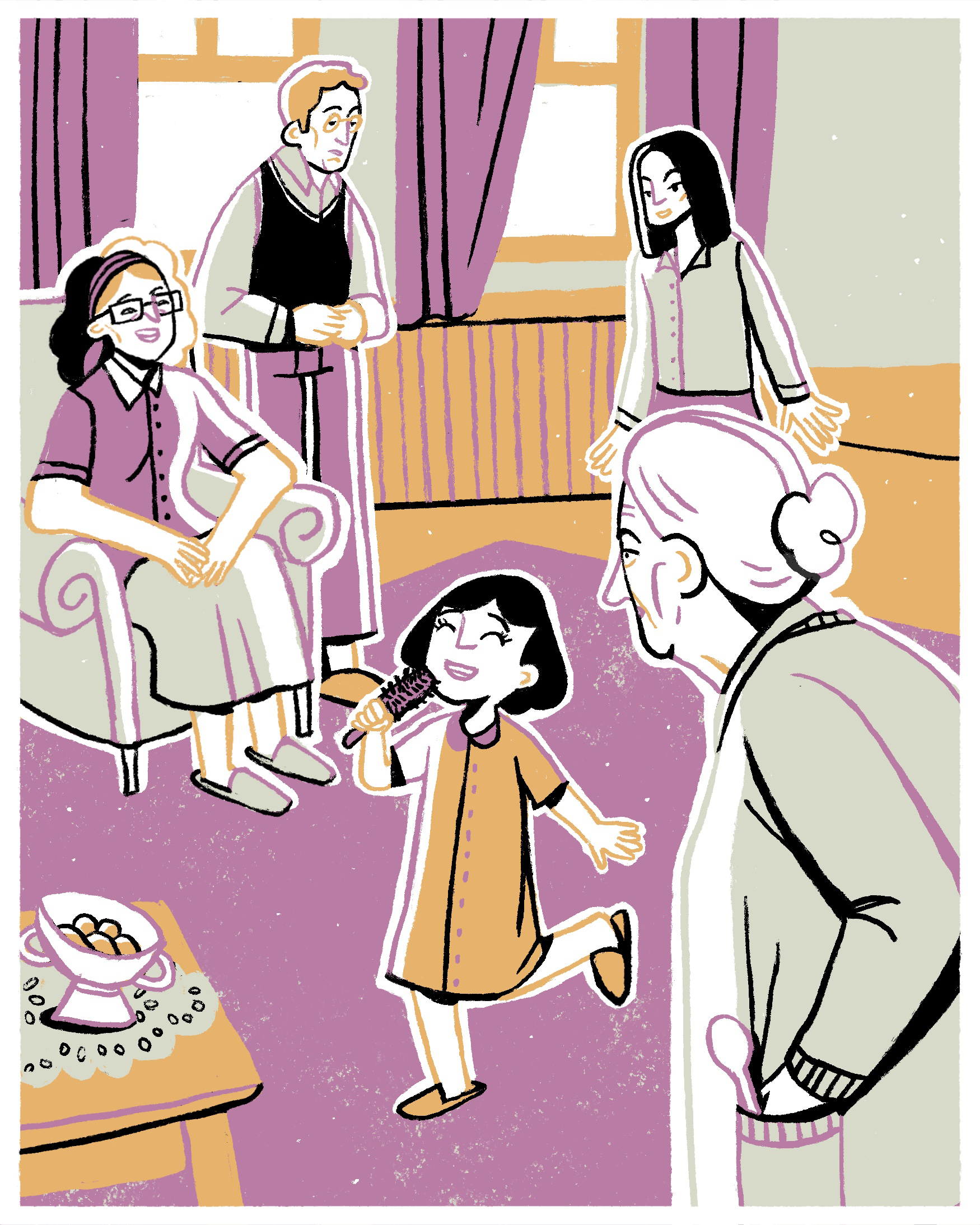
Now whenever you go to her house, the transistor radio is always on, she sings along while cooking, combing her daughter’s hair, washing Strato’s shirts, ironing the petals of her fabric flowers… She knows the lyrics of all songs by heart, Greek or Turkish.
Illustrator: Eda Çağıl Çağlarırmak
“Good thing Kosta has a nice tenor voice,” Gliko would think; because her own voice was terrible and no one in the family had a good voice. Otherwise people might wonder where this girl got such a God-given beautiful voice.
…Today our nerves are on edge, maşallah. She didn’t just scold us with “You’ll destroy the house,” “What’s all this noise,” she pulled Margarita’s braid, Margarita bit her, then as she went upstairs she pinched my arm. It hurt a lot but I didn’t scream; I just shot her an ice-cold look because I know that angers her more. She left me and stormed into her room slamming the door.
Since last year when she turned thirteen she has her own room. It was a tiny closet we used for storage; she insisted, “I can’t study with these babies.” So Todori was called, painted the room nicely, then fit a bed and a bookshelf that opens into a desk. I wish I had such a foldable desk too, instead of writing on the middle table or my knees like now. Anyway, she locks herself in there from morning to evening. Her friend Roza comes too, they study together. I think all they do is chat, laugh secretly, and Mom brings them breakfast things at five so they rest. But we saw her report card. She barely passed the class. I’m sure teacher Mr. Nestoras went easy on her, after all he’s Dad’s tavla friend. I don’t have my own room, don’t study much, but I’m first in class. My teacher says so too.
That’s enough for today. Good night.
“Ah Niki, you always thought so highly of yourself.” But it was true Niki was a good student. While Margarita helped move the vice-principal’s office at Zapyon, she found piles of honor lists in a cabinet. Throughout her years at school Niki’s name was first or second. She always boasted about her performance and how easily she achieved it. She had no tolerance for others’ weaknesses. She wouldn’t make any effort to teach simple things, “Why don’t compound numbers go into your head, I really don’t understand, Margarita,” she’d say.
But teachers never held her up as an example to other kids who had a sister at the same school, like they did to others. Their situation was really hard. What could they say, “Try to be like your sister,” how could they?
There was a literature teacher who was a friend of her husband Pateranga’s; only he occasionally pulled Margarita aside to ask about Niki. Once, worried, “How is Niki? Do you hear from her?” Margarita turned bright red, could only whisper a few words, that Niki wrote letters to her big sisters occasionally, she was fine. The teacher lady shook her head pityingly. She too mourned the wasted great talent inside.
The Niki issue was actually a taboo in their whole circle; no one ever mentioned it; Margarita burned for years with the desire to catch Niki and give her a good beating.

Refusal of Obedience
Rea Stathopulu
From Rea Stathopulu’s book Pedal Çeviren Kadınlar (Women Who Pedal), which tells the story of a Rum family in Istanbul from the 1950s to the 1970s through a little girl’s diary and family relationships, showing how forced departure affected lives and identities — we have included a section in the inVISIBLE TRACES? exhibition as a narrative of empowerment, with the author’s permission.
How to look at Turkish history through the stories of six women at different ages, from childhood to adulthood? Especially if one of them is Grandmother Klioniki, and Grandmother Klioniki lived through the painful pogrom against non-Muslims, especially Rum, in Istanbul and some other cities on 6–7 September 1955?
If she witnessed the destruction of Rum homes, businesses, and places of worship during the attacks, looting, deaths, and rapes, and was forced to migrate due to the traumatic events? We read Pedal Çeviren Kadınlar with these questions, focusing only on Grandmother Klioniki, and thought about Grandmother Klioniki.
Grandmother Klioniki does not narrate 6–7 September, does not do political analysis, does not write memoirs. But in her own way she begins to reckon with both the pogrom and patriarchy. Unable to stay still with the trauma seeping into her behavior, she disrupts household order, distributes her money, loses sense of space and time.
Graphic Design: Ferhat Akbaba

Rea Stathopulu
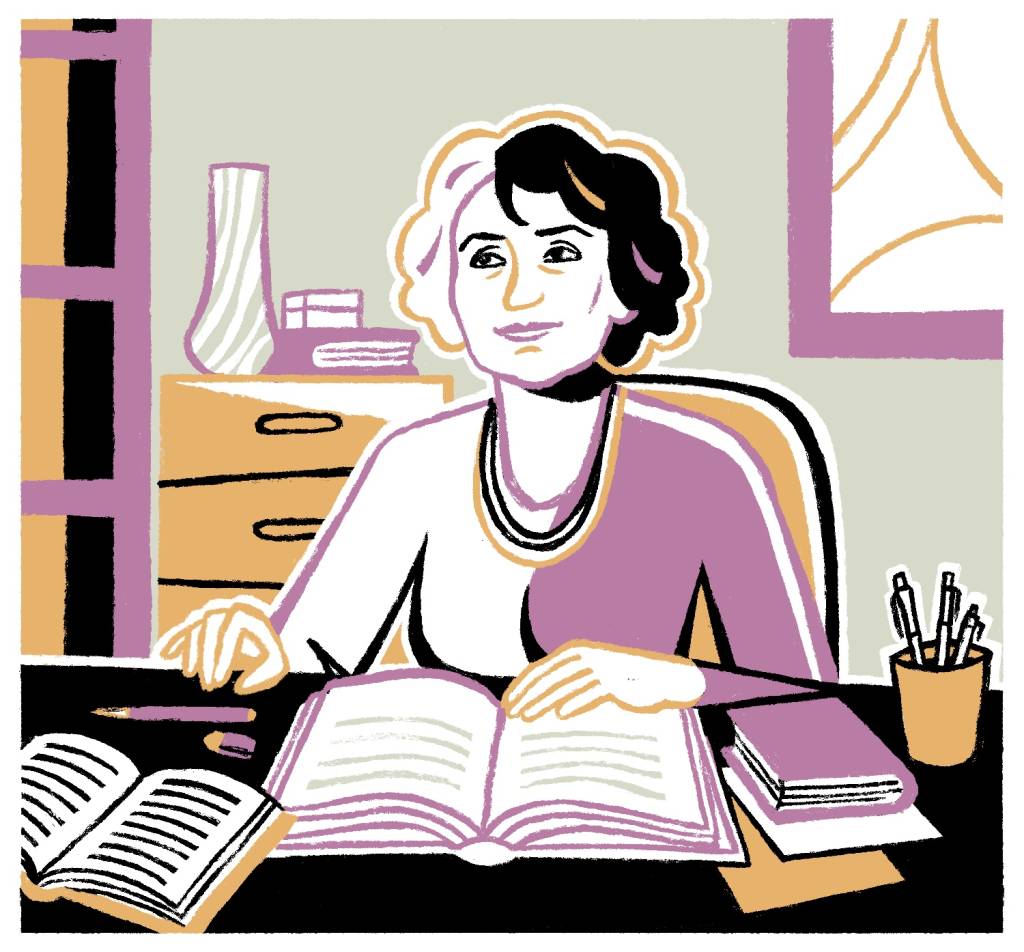
Rea Stathopulu was born in 1950 in Istanbul. She spent her childhood and youth in Istanbul and Imbros (Gökçeada), then moved to Greece. Holding a doctorate in physics, Rea Stathopulu also has a postgraduate diploma in History and Philosophy of Science. She has published another novel, O Vasilias ton Arithmon (The King of Numbers). Pedal Çeviren Kadınlar was published in 2006.
—
The book Pedal Çeviren Kadınlar (inVISIBLE TRACES?), first Turkish edition in 2006, is a novel that fictionalizes what a Rum family went through in Turkey between 1955–1975 through a little girl’s diary and a young girl’s thoughts. The work includes significant parts about Gökçeada.
“When writing the novel, I wanted more to introduce our life in Istanbul and Imbros to readers in Greece, to tell the events that led us to decide to leave there. If the novel is perceived as a step toward illuminating our common past, toward the two nations better knowing and understanding each other, I would be pleased.”
(Sema Aslan, Milliyet Kitap Supplement, July 2006)